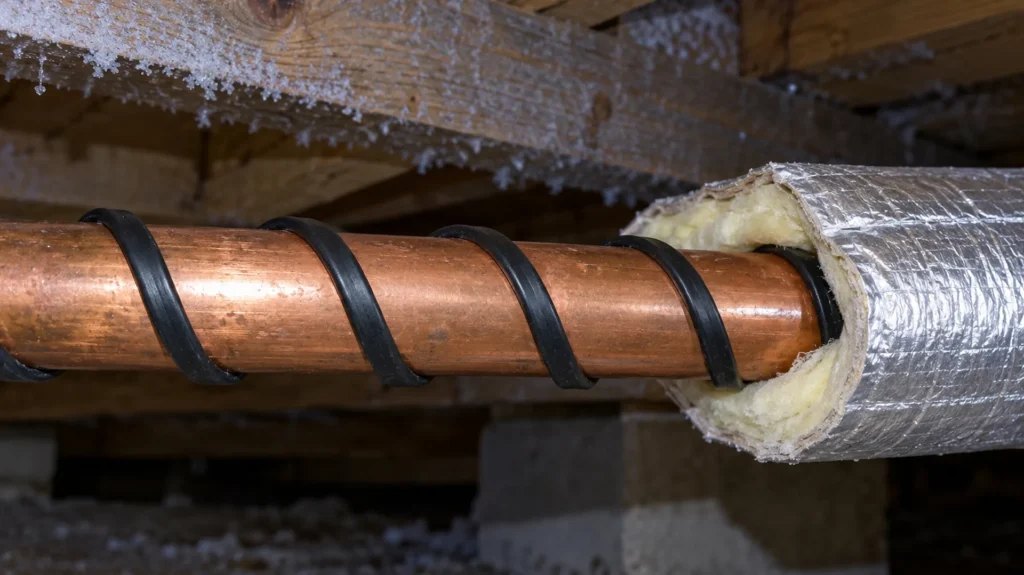
Heat Trace for Yukon Water Lines: Keeping Pipes Thawed Without Starting a Fire
In a Whitehorse winter, a frozen water line is not an inconvenience. It can mean no water for days, a split pipe that floods a crawlspace when it thaws, or a well line that has to be dug up in March. For many homes in the territory, a length of heat trace cable is the only thing standing between a working water supply and that call.
Heat trace (often called heat tape) is a simple product: an electric cable that runs along a pipe and keeps it above freezing. Because it is simple, it is often installed casually, plugged into whatever outlet is nearby, wrapped in leftover insulation, and forgotten for a decade. That is where the trouble starts. A heat trace system works unattended, in hidden spaces, through the coldest months of the year. When it fails, it either stops heating or, worse, starts overheating.
This guide covers how heat trace works, how to tell when yours is past its life, and what a safe installation looks like, so you can check your system before the deep cold arrives.
How Heat Trace Works: Two Very Different Cables
Nearly all residential heat trace falls into one of two types. They look similar on the shelf, but they behave very differently, and mixing up their installation rules is one of the most common causes of failures.
Constant-wattage Cable
Constant-wattage cable puts out the same heat per foot no matter how warm or cold the pipe is. It is the inexpensive pre-cut product sold in fixed lengths with a plug on one end, usually with a small thermostat built in near the end of the cable that switches it on when the pipe temperature drops close to freezing.
The weakness is that it never backs off. Wherever the cable crosses over itself, or wherever it sits under too much insulation, heat builds up with nowhere to go. That is why constant-wattage cable must never overlap or touch itself, and why it can only be insulated with the materials its manufacturer specifies. The built-in thermostat only senses temperature at one spot, so it cannot protect a section that is overheating somewhere else along the run.
Self-regulating Cable
Self-regulating cable has a conductive polymer core between its two bus wires. As the core warms, its resistance rises and its heat output drops. As it cools, output rises again. Each section of the cable responds to the temperature right where it sits, so a section along a cold exterior wall works harder than a section in a warmer part of the crawlspace.
That self-limiting behaviour makes self-regulating cable far more forgiving. Most products can touch or cross over themselves without damage (check the manufacturer’s instructions), and they can be cut to length for a custom run. They cost more up front, but for a well line, a long run, or any pipe in a space you rarely visit, they are the better choice.
Which One Do You Have?
If your cable came in a box with a fixed length and a moulded plug, it is almost certainly constant-wattage. Self-regulating cable is usually flatter, has printed markings along its jacket showing the output in watts per foot, and is connected with a separate end seal and power connection kit.
Signs Your Heat Trace Is Failing
Heat trace does not last forever. The jacket is exposed to years of heating and cooling, rodents in crawlspaces, UV on exposed runs, and the occasional knock from a boot or a shovel. Check for these warning signs:
- Cracked, brittle or discoloured jacket. Browning, melting, or stiff sections mean the cable has been running hot. Replace it, do not tape over it.
- A pipe that freezes anyway. If the line froze with the cable plugged in, either the cable has failed, the thermostat has failed, or the cable is undersized for the pipe and location.
- Scorch marks on insulation or nearby wood. This is a fire warning. Unplug the cable and have the run inspected before using it again.
- A ground-fault device that keeps tripping. Moisture is getting into a damaged section of cable or a connection. Resetting it repeatedly does not fix the problem.
- No indicator light. Many plug-in cables have a small light showing they are powered. A dark light in cold weather is worth investigating.
- Age. If you do not know when the cable was installed, or it predates your ownership of the house, assume it is due for a close look.
A simple cold-weather test: on a cold day, carefully feel the insulated pipe or the cable where it is exposed. A working cable will be noticeably warmer than the surrounding air. A cable at air temperature is not doing its job.
Why the Circuit Matters as Much as the Cable
A well-made cable on a poor circuit is still a poor installation. Three things make the difference.
Ground-fault Protection is Required
The Canadian Electrical Code requires ground-fault protection on heat tracing installations. The reason is straightforward: heat trace lives in damp crawlspaces and against metal pipes, and a nicked jacket can leak current into the pipe or the ground. A ground-fault device detects that leakage and cuts power before it becomes a shock or a fire.
There is a practical wrinkle. A standard household GFCI receptacle trips at about 5 milliamps, which suits bathrooms and kitchens. Long runs of heating cable can have a small amount of normal leakage, enough to cause nuisance trips on a GFCI. Larger systems are often protected by a ground-fault breaker with a higher trip setting designed for heating equipment. Choosing the right protection for the length and type of cable is part of a proper installation, and it is why a heat trace circuit that trips repeatedly should be looked at rather than moved to an unprotected outlet.
No Extension Cords
Plugging heat trace into an extension cord is one of the most common setups we see, and one of the riskiest. Extension cords are designed for temporary use. Run all winter in a crawlspace, a cord’s connections loosen, collect moisture and frost, and heat up under a continuous load. The cord may also be undersized for the cable’s current. If your heat trace does not reach an outlet, the answer is a properly located outlet, not a cord.
A Dedicated, Accessible Circuit
Heat trace runs for long stretches during cold spells, so it should not share a circuit with a freezer, a sump pump or a block heater outlet. Overloaded shared circuits trip at the worst time, and in a crawlspace you may not notice for days. A dedicated circuit, an outlet close to where the cable starts, and a protective device you can reach and test make the system reliable.
In the Yukon, a new circuit or outlet requires an electrical permit and inspection. That inspection is your assurance that the protection, wiring and connections are correct for a load that will run unattended.
Installation Details That Make It Last
Installation Details That Make It Last
Most heat trace failures trace back to a few installation details. Whether you are inspecting an existing run or planning a new one, these are the points that matter.
- Match the cable to the pipe. Output is rated in watts per foot. A small copper line in a heated crawlspace needs far less than a well line exposed at a frost-prone wellhead. Undersized cable freezes; oversized constant-wattage cable can overheat.
- Run it along the bottom of the pipe. Water freezes first at the bottom of a horizontal pipe, and heat rises. Lay the cable straight along the underside, or spiral it only if the manufacturer specifies spiralling for your pipe size.
- Use aluminum tape on plastic pipe. PEX and PVC conduct heat poorly. Most manufacturers call for aluminum foil tape over the cable on plastic pipe to spread the heat around the circumference and prevent hot spots.
- Insulate, but with the right material. Insulation keeps the heat on the pipe and dramatically reduces running cost. With constant-wattage cable, use only the insulation type and thickness the manufacturer allows. Some prohibit certain materials outright.
- Protect valves, fittings and meters. These are the thickest and coldest points on a line and the first to freeze. Manufacturers specify extra cable length at each fitting.
- Seal the ends and connections. On self-regulating cable, the end seal and power connection keep moisture out of the core. A poorly made end seal is a common source of ground-fault trips.
- Never bury or enclose it where it was not designed to go. Cable rated for exposed pipe is not necessarily rated for direct burial, inside a wall, or under foam. Check the rating for the location.
- Label it. A tag at the outlet or panel reading “heat trace, water line” saves the next person from unplugging it to use the outlet for something else.
A Fall Heat Trace Checklist
Before the first real cold snap, spend twenty minutes on your system:
- Locate every run of heat trace in the house: crawlspace, well pit, under a mobile home, along any exposed supply line.
- Inspect the jacket along its full length for cracks, browning, chew marks or flattened sections.
- Confirm each cable plugs directly into a properly located outlet, not an extension cord or power bar.
- Press the test button on the GFCI or ground-fault breaker and confirm it trips and resets.
- Check that insulation is intact, dry and the type your cable allows.
- Look for scorch marks on insulation, framing or nearby materials.
- On the first cold day, confirm the cable is warm and any indicator light is on.
If anything on that list raises a question, deal with it now. Replacing a cable in October is a routine job. Thawing a frozen well line at -35°C is not. For more on how cold-weather loads add up across a home, see our article on winter electrical loads in the Yukon, and for broader warning signs, signs your wiring needs attention.