Brightening the North: The Strategic Advantage of LED Signage and Commercial Lighting for Yukon Businesses
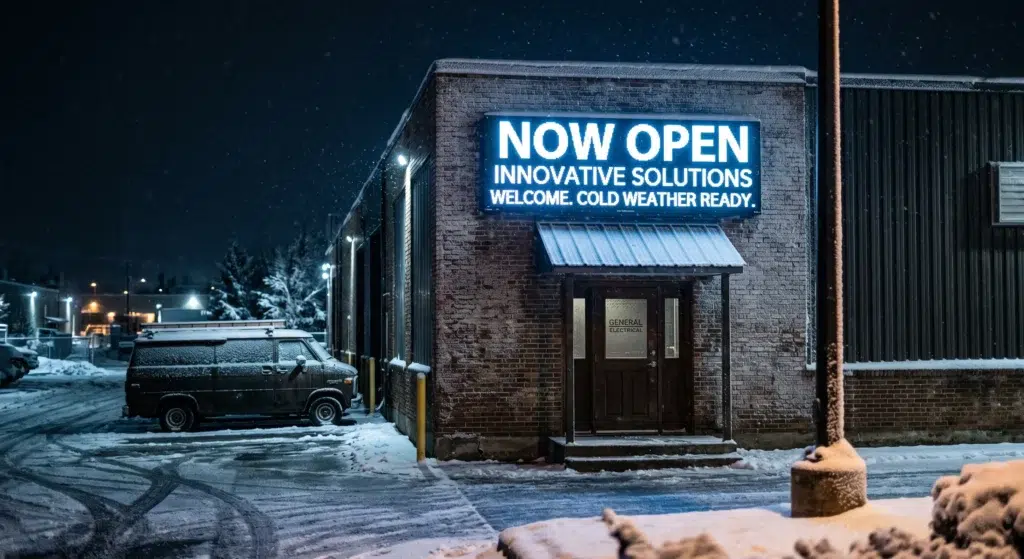
In the Yukon, where the “Midnight Sun” gives way to months of “Polar Night,” light is more than just a utility—it is a beacon of commerce. For a small business in Whitehorse or a manufacturer in the surrounding areas, your exterior visibility is often the only way customers know you are open for business when the sun sets at 4:00 PM.
As a business owner or manager, transitioning to LED (Light Emitting Diode) technology isn’t just about “going green”; it’s a calculated engineering and financial decision designed to withstand one of the harshest operating environments on Earth.
Part 1: Why LEDs Love the Cold (The Northern Advantage)
One of the most persistent myths in commercial maintenance is that high-tech lighting is fragile. In reality, LED technology is uniquely suited for the Yukon because, unlike traditional fluorescent or High-Intensity Discharge (HID) lamps, LEDs actually thrive in the cold.
1.1 Thermal Management and Efficiency
Standard fluorescent tubes rely on a chemical reaction that struggles in sub-zero temperatures, often flickering or failing to reach full brightness when the mercury drops below -20°C. LEDs, however, are solid-state semiconductors. They generate less waste heat, and the cold ambient air acts as a natural heat sink, effectively extending the life of the internal components. In the North, an LED system often operates more efficiently and lasts longer than its rated lifespan in warmer climates.
1.2 Instant-On Performance
When a motion sensor trips in a dark storage yard or a shop door opens, you need light immediately. HID lamps require a “warm-up” period, often taking several minutes to reach full luminosity. LEDs provide 100% brightness instantly, regardless of the temperature, ensuring that safety and visibility are never delayed.
Part 2: Commercial Signage: Your 24/7 Silent Salesman
For retail and small businesses, your signage is your primary brand touchpoint. In the dark winter months, a dim or flickering sign sends a message of neglect or closure.
2.1 Visual Impact and Color Rendering
The quality of light matters. Modern LEDs offer a high Color Rendering Index (CRI), meaning they represent colors more accurately to the human eye. For a retail storefront, this means your branding looks vibrant and crisp against the monochromatic backdrop of a Yukon winter.
2.2 Cutting Through the Fog and Snow
LED signage offers superior directional light control. While traditional bulbs scatter light in all directions, LEDs can be engineered with specific optics to punch through heavy snowfall or ice fog, ensuring your business remains visible from the road even in “whiteout” conditions.
2.3 The “Set It and Forget It” Factor
For a small manufacturer, the last thing you want to do in January is hire a bucket truck to replace a ballast or a burnt-out bulb in a pylon sign. The cost of the labor and equipment rental often far exceeds the cost of the light itself. With an L70 rating (the time it takes for a light to lose 30% of its brightness) often exceeding 50,000 to 100,000 hours, LED signage virtually eliminates mid-winter maintenance headaches.
Part 3: Expanding the Perimeter: Outdoor Commercial Lighting
Visibility shouldn’t stop at your front door. Comprehensive outdoor lighting is a critical component of risk management and operational efficiency for any Yukon business.
3.1 Safety and Liability
Slip-and-fall accidents are a significant liability for businesses in snowy climates. Proper illumination of parking lots, walkways, and loading docks is the first line of defense. By using Wall Packs and Bollard Lights, you ensure that ice patches and uneven surfaces are clearly visible to employees and customers alike.
3.2 Security and Crime Deterrence
A well-lit facility is a difficult target. Bright, consistent exterior lighting eliminates “blind spots” for security cameras and discourages unauthorized access. For small manufacturers with exterior inventory or equipment yards, high-output LED floodlights provide a cost-effective alternative to 24/7 physical security.
3.3 Employee Productivity
For businesses that operate early shifts or late nights, the quality of outdoor lighting affects morale and safety. Loading a truck at 7:00 AM in pitch blackness is hazardous. High-uniformity LED lighting (lighting that is even across a space without “hot spots” or deep shadows) creates a safer and more productive work environment.
Part 4: The Technical Logic for Management Decisions
When presenting an upgrade to stakeholders, it’s important to speak the language of Total Cost of Ownership (TCO) and Return on Investment (ROI).
4.1 Luminous Flux vs. Wattage
We are used to buying bulbs based on Watts (energy used), but in the LED era, we buy based on Lumens (light produced). An LED fixture can often produce the same amount of light as a 400W Metal Halide lamp while only drawing 150W. This 60-70% reduction in energy consumption goes directly to the bottom line.
4.2 Power Quality and Drivers
In the Yukon, power fluctuations can occur. A “cheap” LED from a big-box store often fails because of a low-quality driver (the component that converts AC to DC). Professional-grade commercial LEDs use high-specification drivers with surge protection, ensuring that your investment survives minor grid fluctuations common in remote areas.
4.3 Light Pollution and “Dark Sky” Compliance
Whitehorse is beautiful because of its natural surroundings. Modern LED fixtures allow for “Full Cutoff” designs, meaning the light is directed exactly where it’s needed (the ground or the sign) and not spilled up into the night sky. This efficiency isn’t just neighborly; it’s more light for your dollar.

Part 5: Why Professional Planning is Essential
While the advantages of LEDs are clear, the “how” is just as important as the “what.” A haphazard installation can lead to glare, uneven lighting, or premature failure due to poor weather sealing.
- Load Calculations: Ensuring your existing electrical panels can handle the transition (especially if adding more fixtures for better coverage).
- Mounting and Wind Loads: In the Yukon, signage must be mounted to withstand high wind loads and heavy ice accumulation.
- Circuit Optimization: Grouping lights onto smart timers or photocells ensures you aren’t paying to light an empty parking lot at 3:00 AM, while still maintaining security levels.
Investing in the Future of Your Business
For Yukon small businesses and manufacturers, lighting is a strategic asset. Upgrading to LED signage and professional outdoor lighting isn’t just an aesthetic choice—it’s an investment in safety, visibility, and long-term operational savings.
By eliminating the mid-winter “sign-out” and significantly reducing your monthly utility bill, you free up resources to focus on what matters most: growing your business in the North. When the lights are bright, consistent, and professional, your customers know that your business is, too.
Ready to light up your storefront? Whether you need a signage retrofit or a complete parking lot overhaul, Moffat Electrical Contracting understands the unique engineering requirements of the Yukon. Let’s make sure your business is the brightest spot on the block this winter.