From "Spaghetti" to Structure: Why Your Yukon Business Needs a Professional Data Backbone
In the modern business landscape, data is often described as the “new oil,” but for a local business or small manufacturer, data is more like the central nervous system. Whether you are running a retail storefront in Whitehorse or managing a fabrication shop in a remote corner of the territory, your ability to process payments, manage inventory, and communicate with clients depends entirely on the physical layer of your network.
Many businesses treat data cabling as an afterthought—something to be tucked behind a desk or run through a ceiling tile in a tangled “spaghetti” of blue and gray wires. However, as we move toward high-bandwidth cloud services, VOIP (Voice over IP) phone systems, and real-time industrial monitoring, the “patch-it-together” approach is no longer a viable strategy.
For the business owner, structured cabling is about productivity. For the General Contractor (GC), it is about risk mitigation and professional handover. This article explores why professional data integration is the single most important infrastructure investment you can make this year.
The Business Case: Why "Good Enough" is Costing You Money
For a small business manager, it can be tempting to rely on Wi-Fi for everything. While wireless technology has improved, it remains a “shared medium” subject to interference, physical barriers, and bandwidth congestion.
1.1 Eliminating the “Buffer” in Your Bottom Line
Every second an employee waits for a cloud-based database to refresh or a VOIP call to reconnect is lost revenue. Structured cabling provides a dedicated, interference-free lane for your data. By offloading static devices (desktops, printers, point-of-sale terminals) to a wired connection, you free up your Wi-Fi “airwaves” for mobile devices and guest access, significantly improving overall network stability.
1.2 VOIP and Unified Communications
If your business has moved to a VOIP system, the quality of your cabling directly dictates the quality of your voice calls. Unlike standard web browsing, voice data is extremely sensitive to jitter and latency. A poor-quality termination or a kinked cable can result in dropped words and frustrated customers. A professional structured data install ensures that your voice traffic is prioritized and crystal clear.
The Contractor’s Edge: Why Subcontracting Data to MEC Makes Sense
If you are a General Contractor (GC) managing a new build or a major renovation in the Yukon, you know that your reputation is only as good as your last handover. While many “sparkies” can pull a cable through a wall, there is a massive difference between a cable that works and a cable that is certified.
2.1 The “One-Stop” Advantage
Hiring an electrical contractor like MEC to handle both power and data creates a seamless workflow. GCs often face logistical friction when trying to coordinate between a traditional electrician and a separate “IT guy.” By utilizing a team that understands the interplay between high-voltage interference and low-voltage sensitivity, you eliminate the finger-pointing that often happens when a network underperforms post-occupancy.
2.2 Certification and Testing (The Professional Handover)
A professional data installation isn’t finished when the cable is pulled; it’s finished when it’s tested. MEC provides GCs with a “Birth Certificate” for their network. Using specialized testing equipment, we verify that every drop meets the specific frequency requirements (e.g., $250\text{ MHz}$ for Cat 6) and distance limitations.
For a GC, providing the client with a printed test report for every data outlet isn’t just a value-add—it’s a shield against future liability. If the client has IT issues six months later, you have the documentation proving the physical layer was perfect upon delivery.
The Technical Hierarchy: Beyond the Blue Wire
While we have previously discussed the basic speeds of Cat 5e and Cat 6, it is important to understand where these fit into a structured environment.
- Cat 6 and 6A (The Gold Standard): For modern offices, Cat 6 is the minimum. Cat 6A (Augmented) is recommended for runs that require 10Gbps speeds or are located in environments with high electromagnetic interference, such as manufacturing floors.
- Fiber Optic Backbones: In larger facilities or multi-building sites, copper has a physical limitation of approximately 100 meters. For runs exceeding this, or for connecting “IDF” (Intermediate Distribution Frame) closets back to the main server room, fiber optics are a necessity.
- PoE (Power over Ethernet): This is where the world of the electrician and the data tech truly collide. Modern security cameras, access control systems, and even some LED lighting are powered through the data cable. A professional understands the thermal management required when bundling dozens of PoE cables together; if not handled correctly, the heat generated by the power draw can actually degrade the data signals.
The Northern Reality: Industrial-Grade Data
The Yukon presents specific challenges that a standard “Southern” IT manual might not cover.
4.1 Temperature and Jacket Integrity
Standard PVC data cables can become brittle and crack in extreme cold. If cables are being run through unheated warehouses or external conduits, we utilize LSZH (Low Smoke Zero Halogen) or specialized outdoor-rated jackets that maintain flexibility and signal integrity at -40°C.
4.2 Shielding in Manufacturing
For our small manufacturers, the electrical “noise” generated by heavy machinery, welders, and large motors can wreak havoc on data signals. In these environments, we utilize Shielded Twisted Pair (STP) cabling and specialized grounding techniques to ensure your CNC machines and inventory trackers remain online even when the heavy equipment is running at full tilt.

The "Digital Map": Documentation and Maintenance
The biggest frustration for any business owner is opening a server closet and seeing a “nest” of unlabeled cables. Structured cabling is about organization.
- Standardized Labeling: Every outlet in the building should have a corresponding label on the patch panel in the server room. This reduces troubleshooting time from hours to seconds.
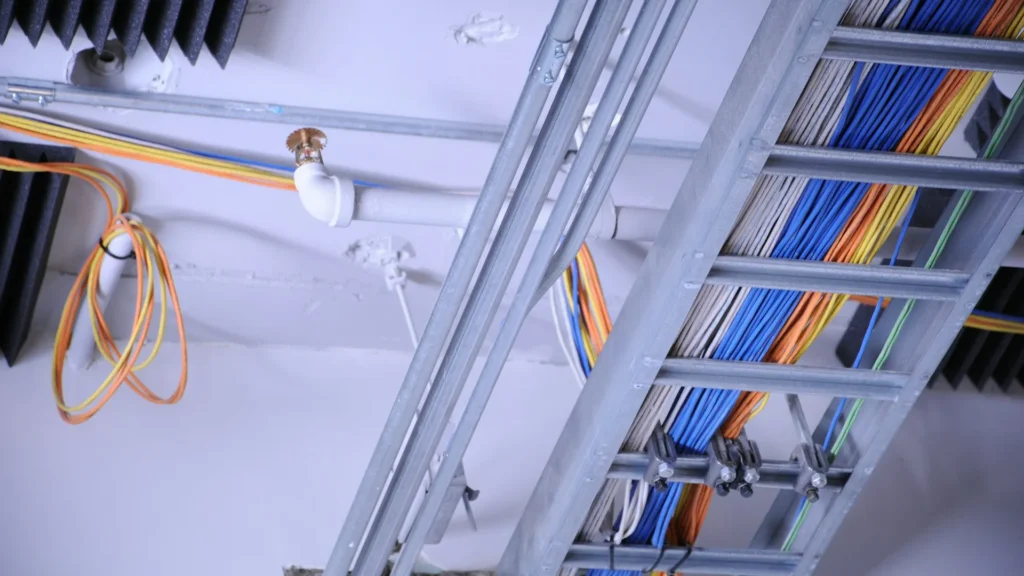
- Cable Management: Utilizing proper “D-rings,” cable trays, and rack management ensures that the weight of the cables doesn’t strain the connections over time.
- Future-Proofing: We always recommend pulling “service loops” and extra drops. The cost of pulling a second cable while the walls are open is pennies; the cost of coming back to add one later is hundreds of dollars.
Conclusion: A Foundation for Growth
Structured data is not a “tech” luxury; it is a fundamental utility, just like water or electricity. For the Yukon business owner, it is the key to operational efficiency and professional communication. For the General Contractor, it is a way to ensure a high-quality, documented project delivery that stands up to the rigors of the North.
Whether you are setting up a small retail shop or a sprawling industrial facility, don’t let your data be the bottleneck. By investing in a professionally installed, tested, and labeled cabling system, you are ensuring that your business is ready for the digital demands of today—and whatever comes next.
Interested in strengthening your intranet backbone? Trust Moffat Electrical to design and install your network. We’ll keep it neat, well documented, reliable, and expandable.